We value Church planting as one of our core principles. We believe in expanding God’s Kingdom, biblical beliefs, values, and teachings to people in and around the city, state, nationally and internationally.
Why we have taken the series of values is to make us aware of what this church is all about what we believe and why we believe as a church.
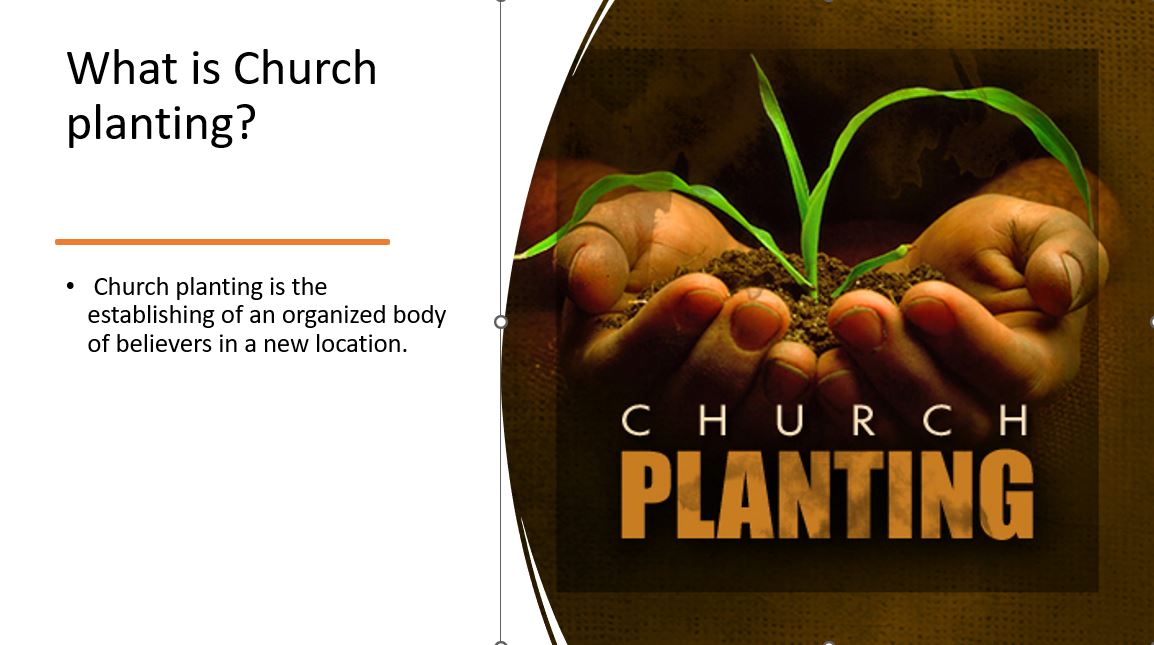
What is Church planting?
Church planting is the establishing of an organized body of believers in a new location.
For example , Renewed hope community is birthed by our Mother Church which is located in Colaba ,Mumbai. They planted in this new location of Panvel years back.
As a Church we have set a target to plant a church. Our ultimate Goal or God’s ultimate goal is that we spread out in and around the city , outside the state , outside our country through church plants.
And yesterday , I witnessed a church plant which took place in Australia.
The normal response to discussions about church planting is something like this.
A.“We already have plenty of churches that have lots and lots of room for all the new people who have come to the area. Let’s get them filled before we start building any new ones.”
B.“Every church in this community used to be more full than it is now. A new church here will just take people from churches that are already hurting and will weaken everyone.”
C.“Help the churches that are struggling first. A new church doesn’t help the existing ones that are just. . We need better churches, not more churches.”
These statements appear to be common sense to many people, but they rest on several wrong assumptions. The error of this thinking will become clear if we ask, “Why is church planting so crucially important?”
The church-planting focus is biblical. As the apostle Paul travelled through an area, he always tried to spend enough time in each city to establish a local body of believers and train the leadership (Acts 14:21-23). Later, he would try to revisit those churches to confirm and encourage them in the faith (Acts 15:41; 1 Thessalonians 3:2). The churches he established would then begin to send out missionaries themselves, and so the work of church planting continued (1 Thessalonians 1:8).
Why we Plant Churches?
- Church Planting is Biblical.
Mathew 28:19,20 includes – Great commission involves Making disciples AND Baptizing them.
It calls to plant churches, not simply to share the faith. The Great Commission (Matt. 28:18–20) is a call not just to “make disciples” but to baptize. In Acts and elsewhere, it is clear that baptism means incorporation into a worshiping community with accountability and boundaries (cf. Acts 2:41–47). The only way to be truly sure you are increasing the number of Christians in a town is to increase the number of churches.
Why would this be? Much traditional evangelism aims to get a “decision” for Christ. Experience, however, shows us that many of these decisions disappear and never result in changed lives. Many decisions are not really conversions but are only the beginning of a journey of seeking God. (Other decisions (Other decisions are very definitely the moment of a “new birth,” but this differs from person to person.) Only a person who is being evangelized in the context of an ongoing worshiping and shepherding community can be sure of finally coming home into vital, saving faith
Acts 2: 41-47 After 3000 people were baptized they “joined” themselves to the original 12 or 120 disciples. So church was instantly formed.
N.T. way of expanding the gospel – Trace the expansion of church through Jerusalem, Judea, Samaria at the uttermost part of the earth and the church planters led the way.
The cities where the churches planted are Jerusalem, Samaria, Damascus, Antioch, Cilicia, Ephesus, Rome, Corinth, Galatia, Thessalonica, Colossae, Philippi, Cenchreae, Island of Crete, Cyprus, Athens, Achaia, Berea, Phrygia, Iconium, Lystra & Derbe, etc.
- PAUL’S WHOLE STRATEGY WAS TO PLANT URBAN CHURCHES
The greatest missionary in history, Saint Paul, had a rather simple twofold strategy. First, he went into the largest city of a region (cf. Acts 16:9, 12), and second, he planted churches in each city (cf. Titus 1:5—”appoint elders in every town”). Once Paul had done that, he could say that he had “fully preached” the gospel in a region and that he had “no more place . . . to work in these regions” (cf. Rom. 15:19,23). This means Paul had two controlling assumptions: (a) that the way to most permanently influence a country was through its chief cities, and (b) the way to most permanently influence a city was to plant churches in it. Once he had accomplished this in a city, he moved on. He knew that the rest that needed to happen would follow.
Consider these facts of New Church Plan:
- NEW CHURCHES BEST REACH NEW GENERATIONS, NEW RESIDENTS, AND NEW PEOPLE GROUPS
First, younger adults have always been disproportionately found in newer congregations. Long-established congregations develop traditions (such as time of worship, length of service, level of emotional responsiveness, sermon topics, leadership style, emotional atmosphere, and thousands of other tiny customs and mores)
Second, new residents are almost always reached better by new congregations. Older congregations
may require a tenure of ten years before someone is allowed into places of leadership and influence,
but in a new church, new residents tend to have equal power with long time area residents.
Third, new sociocultural groups in a community are always reached better by new congregations. For example, if new white-collar commuters move into an area where the older residents were farmers, it is likely that a new church will be more receptive to the myriad needs of the new residents, while the older churches will continue to be oriented to the original social group. Also, new racial groups in a community are best reached by a new church that is intentionally multiethnic from the start.
Many people do ask us . why we don’t have Hindi translations. I believe God is calling us for something else. There are many Hindi churches in Panvel but hardly any English churches. Churches have translators, but I believe translation has its only advantages and disadvantages. God has called us for something.
- NEW CHURCHES BEST REACH THE UNCHURCHED
Dozens of denominational studies have confirmed that the average new church gains most of its new members (60–80%) from the ranks of people who are not attending any worshiping body, while churches over ten to fifteen years of age gain 80–90 percent of new members by transfer from other congregations.2
This means the average new congregation will bring six to eight times more new people into the life of the body of Christ than an older congregation of the same size.
Although established congregations provide many things that newer churches often cannot, older churches in general will never be able to match the effectiveness of new bodies in reaching people for the kingdom. Why would this be? As a congregation ages, powerful internal institutional pressures lead it to allocate most of its resources and energy toward the concerns of its members and constituents, rather than toward those outside its walls. This is natural and to a great degree desirable. Older congregations have a stability and steadiness that many people thrive on and need. This does not mean that established churches cannot win new people. In fact, many non-Christians will be reached only by churches with long roots in the community and the marks of stability and respectability.
THE NEW CHURCHES BRING NEW IDEAS TO THE WHOLE BODY
There is plenty of resistance to the idea that we need to plant new churches to reach the constant stream of new groups and generations and residents. Many congregations insist that all available resources should be used to find ways of helping existing churches reach them. There is, however, no better way to teach older congregations about new skills and methods for reaching new people groups than by planting new churches. It is the new churches that have freedom to be innovative, so they become the Research and Development Department for the whole body in the city. Often the older congregations have been too timid to try a particular approach or absolutely sure it would “not work here,” but when the new church in town succeeds wildly with that new method, the other churches eventually take notice and gain the courage to try it themselves.
NEW CHURCHES ARE ONE OF THE BEST PLACES TO IDENTIFY CREATIVE, STRONG LEADERS FOR THE WHOLE BODY
In older congregations, leaders emphasize tradition, tenure, routine, and kinship ties. New congregations, on the other hand, attract a higher percentage of venturesome people who value creativity, risk, innovation, and future orientation. Many of these men and women would never be attracted or compelled into significant ministry apart from the appearance of these new bodies. Often older churches “box out” people who have strong leadership skills but who cannot work in more traditional settings. New churches in a city thus attract and harness people whose gifts would otherwise not be utilized in the work of the body. These new leaders eventually benefit the whole body in the city
THE NEW CHURCHES CHALLENGE OTHER CHURCHES TO SELF-EXAMINATION
In general, the success of new churches often challenges older congregations to evaluate themselves in substantial ways.
What is my part in the entire church planting process?
Each one plays a role, we all have a role to play , some will be pioneers, some will support and stand with them , some will pray, some will open their homes etc
Prepare: When we say church planting , it usually does not start with big hall, It starts from home. If we open our homes , get trained, beginning with a small community (Cell group) etc. It gives a massive opportunity in that place , society. Sometimes we just open a home and give access to prospect leaders in our home.
Support: Support those who are doing it , how to do it ? is by attending. Massive opportunities , All our ministries end product is to raise people in leadership and send them out to plant churches. Do join , we have something for you from Monday to Sunday.
Pray: Pray to God to give us new places , territory. Pray for Pioneers, God will raise them.
Our Journey…. (PANVEL CHURCH)
When we moved to Panvel 8 years back, it was a hard sowing ground. There were no proper infrastructure , we as a family struggled but we were faithful, it began in our home, then we moved to a school and then we moved to a restaurant . God has amazed us in many ways.
What if our church was not planted, what about you , what about X,Y,Z, our street children. I look at their eyes and I cry in my heart.
We trained so many people over the period of years, in music, teaching, serving etc.
There will be many more churches in Panvel in the coming years because that is the only way his kingdom will expand. Does our church be relevant.
Virjil Selvan is Pastoring the Renewed Hope Community. The Renewed Hope Community is situated in the heart of the city between Old and New Panvel. We can confidently share that Renewed Hope Community is a Church in Kamothe, Church in Khandeshwar, Church in Khanda Colony, Church in Karanjade, Church in Panvel, Church in New Panvel, Church in Karanjade because we are centrally located and these places surround our church Venue.

0 Comment