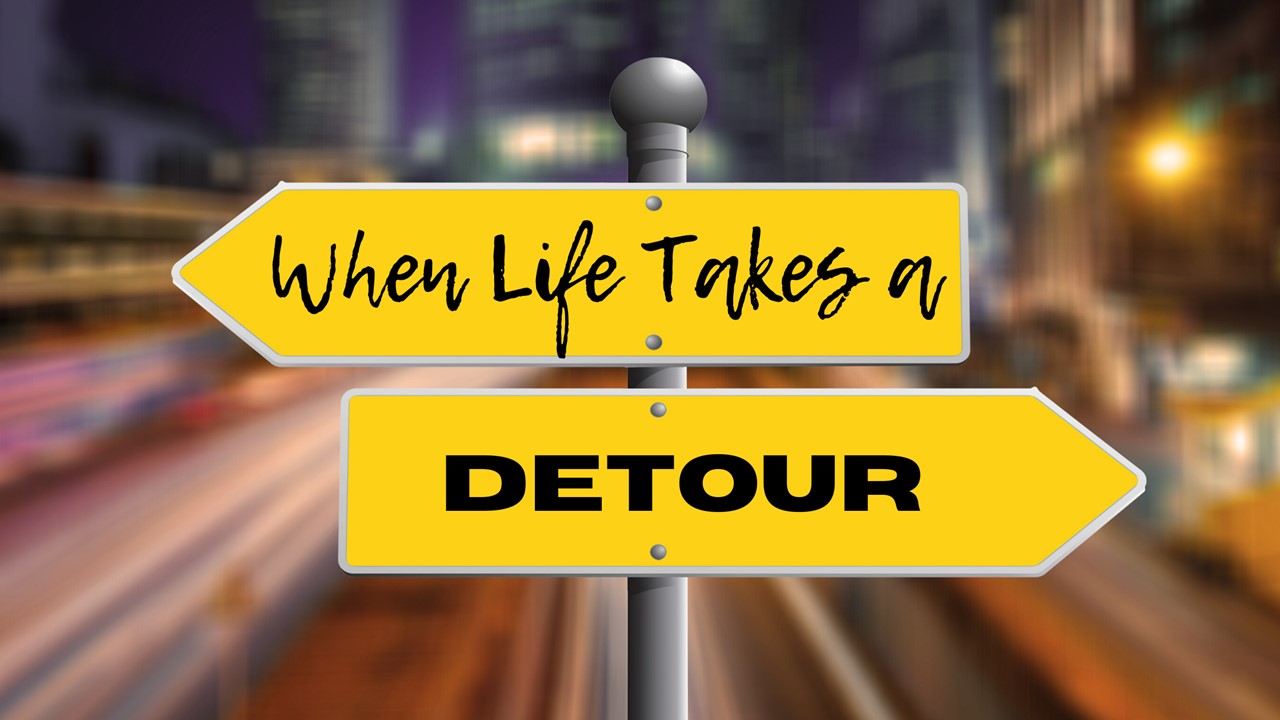
We are starting a new series named Under Construction . When we see anything under construction like bridges , roads etc we see sign boards for next three weeks we are going to look at different sign boards during under construction and how we can apply that in our lives.
- Detour
- Rough Pavement
- Road Closed
Whenever we see something is under construction , we see a sign of detour , that means we have to take a new route.
In India, or in our city , We see some sought of construction of roads , bridges across us when we are driving. So When we see an under construction board or sign we do see lot of other signs like Go slow , Diversions etc.
That means we need to get used to orange barrels, cones, delays and diversion signs on our way to work, school or other destinations. It would seem like our roads are always under construction. The same could be said about our lives as we consider our journey with God. Those who are in a relationship with God will encounter a life full of repairs, rebuilds and restorations. In these three-week series we will look at the lives of biblical characters who underwent a Godly reconstruction. What can the story of these characters’ lives teach us about our own lives?
Today we are going to look at ‘When God allows Detour in our life’.
What does a Detour sign mean?
A Detour sign means that you are being directed through an alternate route to avoid construction on the road you were traveling on.
Signs which are directing us to another route is called as Detour.
We usually don’t like detour signs or simply, when we are redirected to another route. Sometimes , we are aware of the new route and sometimes we are not familiar. It’s always like Not again, I wanted to go from this route , straight not diversions to another route. This new route usually, is not always a pleasant route, lot of traffic jams, narrow road etc.
The Israelites were given a Detour (directed to an alternate route) to the Desert when they came out of Egypt.
Let us look at a bible , a route in the Desert.
Most of us agree that the shortest distance between two points is a straight line. We especially subscribe to this when we are thinking of our lives. It challenges our faith when God does not take us immediately to what we think is our destination.
- Detour are not always easy, in fact, it rarely is. But it’s worth it.
Exodus 13:17-18
17 When Pharaoh let the people go, God did not lead them on the road through the Philistine country, though that was shorter. For God said, “If they face war, they might change their minds and return to Egypt.” 18 So God led the people around by the desert road toward the Red Sea.[a] The Israelites went up out of Egypt ready for battle.
Rather than take the shorter, coastal route to Canaan, God directed Israel southeast toward the Red Sea. The direct route led through the land of the Philistines, and while God could have simply destroyed the enemy (as He would at the Red Sea), His concern lay more with the unprepared and fearful hearts of His people (Exod. 13:17-18).
So God took them the long way. And it seemed pointless. But was it?
God’s deliverance by parting the Red Sea paved the way for Israel to meet God face to face at Sinai—and to receive the Law by which they could live in the Promised Land.
If the goal was simply a destination, God seemed a lousy travel agent. A journey of three weeks would ultimately take 40 years! But God purposed to give His people something far more than a parcel of land; He offered them a changed heart.
SOMETIMES IS THE SHORTEST WAY IS THE LONG WAY
Later, instead of entering the Promised Land from the south where the people now stood, God led them east around Edom.
God took them the long way—again. And it seemed pointless.
As a result, the people “became impatient because of the journey” (Num. 21:1-5). Why take the long way around?
But as the passage unfolds, we read how God gave Israel victories all up and down the King’s Highway so that they ultimately gained control of the majority of Transjordan. This allowed them to prepare to cross over the Jordan River into the Promised Land at Jericho—a location far more strategic than from the south.
The long way ended up the best way after all.
WHY GOD TAKES YOU THE LONG WAY
Often, it seems as if God needlessly extends our journey:
For years we pray but we don’t see any breakthrough.
We plug away endlessly at a miserable job with no promotion.
We wait and wait . . . and wait.
The long way seems the wrong way and, like the Hebrews, we become impatient because of the journey.
Yet when we look back in hindsight, we actually come to appreciate how God used the journey—and all the victories and failures along the way—to prepare us for something we felt ready for much earlier.
TWO VIEWS OF THE LONG WAY
On the long journey, there are two views:
What we see—While we strain to see over the next horizon, God sees the map from above—and so knows the best way to proceed. So the Lord often leads us according to the needs of our heart, not always according to its desires.
What God sees—The Father sees the fear buried in our hearts that the quick and easy way would bring out. In our lives, we must realize that God’s goal for us—the best He could possibly give us—isn’t found in simply taking us from here to there. It isn’t even found in a new biblical insight. These come as but the means of His real goal—to know Him.
Secondly , let us look back from the life of Saul.
Let us read
ACTS 7:57-58
57 At this they covered their ears and, yelling at the top of their voices, they all rushed at him, 58 dragged him out of the city and began to stone him. Meanwhile, the witnesses laid their coats at the feet of a young man named Saul.
ACTS 8:1-3
And Saul approved of their killing him.
The Church Persecuted and Scattered
On that day a great persecution broke out against the church in Jerusalem, and all except the apostles were scattered throughout Judea and Samaria. 2 Godly men buried Stephen and mourned deeply for him. 3 But Saul began to destroy the church. Going from house to house, he dragged off both men and women and put them in prison.
“The best and the brightest.” Saul of Tarsus; a child of the best upbringing; a student of the vaunted teacher, Gamaliel; a Roman citizen; trained in the best Jewish schools; groomed, perhaps, to even become chief priest.
And this pious man was bent on the destruction of the believers in Jesus.
In order to understand Saul of Tarsus it is important that we put him into historical context. Only a few short years had passed from the crucifixion and resurrection of Jesus when a self-righteous religious zealot assisted in the systematic murder of one of Christianity’s earliest messengers, a godly man named Stephen
Saul was one of the most feared men in the first century. He had power, a reputation, and a solid commitment to destroy the new and growing movement of Jesus’ followers.
One day, on a road to the city of Damascus, he was given a detour that jumpstarted a construction project that lasted the rest of his life.
though not one of the original 12 apostles, he ended up becoming “one of the most prolific contributors” to the New Testament, penning at least 13 of the New Testament’s 27 books.
The conversion that transformed human history.
The same way Jesus took us in a different Path, we all were perishing, and the wages of sin was death but Christ died for us. Through the cross we have access to a new way, new destination.
While we are under construction, we will experience detours that will afford God the opportunity to improve our lives.
We are all under construction, God is working on each one of us. We are work in Progress.
Three things we can focus on our Attitude towards Detour this morning.
- Acknowledge and take the Detour
When we are driving , we see a under construction board and sign to take a different route. We usually follow the instructions. We don’t tell ourselves or move our car straight and say no , that I want to go in this direction only. Same way in our lives when God puts the brake and we have to stop in our lives and take a another route which was not planned and not known , take it confidentially and move head. SOMETIMES, THE SHORTEST WAY IS THE LONG WAY
- Character Shaping
In the Desert Journey, God purposed to give His people something far more than a parcel of land; He offered them a changed heart. God will shape or work in our heart or issues during this journey.
- Changed Personality
God changed the zeal and passion of Saul to something better. His Focus changed , His thought changed , his targets changed , his desires changed. He was a changed personality. When he accepted the route that God took him, he was a changed person. In this detour, if we allow God to work , we will see ourselves a changed personality.
Sometimes God applies a break in our lives and takes us through a new route. It is sometimes painful as it is not as per our plans, but we need to trust and move ahead.
Philippians 1:6
6 being confident of this, that he who began a good work in you will carry it on to completion until the day of Christ Jesus.
Virjil Selvan is Pastoring the Renewed Hope Community. The Renewed Hope Community is situated in the heart of the city between Old and New Panvel. We can confidently share that Renewed Hope Community is a Church in Kamothe, Church in Khandeshwar, Church in Khanda Colony, Church in Karanjade, Church in Panvel, Church in New Panvel, Church in Karanjade because we are centrally located and these places surround our church Venue.

0 Comment